Oct 26, 2026News & Insights
Chain Steel Grades: What the Number on the Chain Actually Means
Carbon steel, alloy steel or stainless steel - and a grade number on top. What the steel types are, what the grade number measures, and why material and grade are not the same thing.
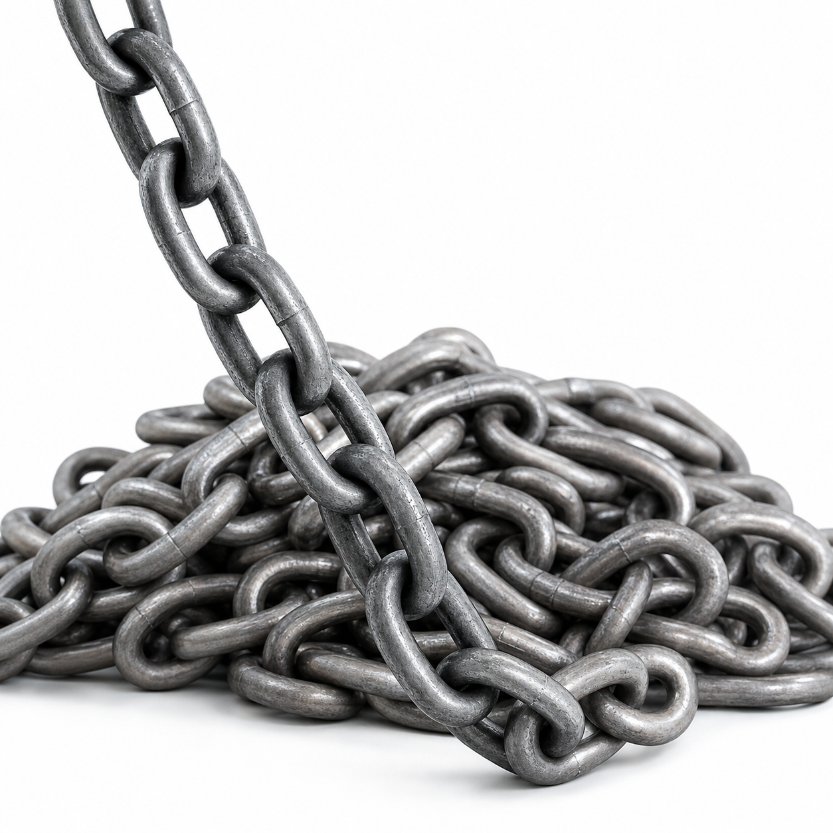
Buyers often mix up two questions about chain: what it is made of, and what grade it is. The material decides how the chain behaves - how it corrodes, how it welds, how it responds to heat treatment. The grade describes the strength class. A chain can be alloy steel and still be a general duty grade.
Three Families of Chain Steel
Chain steel falls into three families. Carbon steel is the base for most commercial chain. Alloy steel adds elements such as manganese, molybdenum, boron or nickel, which change how the steel responds to heat treatment. Stainless steel is chosen for corrosion resistance rather than raw strength. All three are weldable - a welded chain is only as good as its welds.
What the Grade Number Measures
The grade is a statement about strength, not chemistry. It tracks the breaking strength of the steel - force per unit of cross-section - which is why the same grade applies to chains of different sizes. A higher grade means more load for the same link size.
Why Alloy Steel Is Not Automatically a High Grade
Alloy steel is a material choice; the grade is the result of what is done with it. Alloy steel that has not been heat treated sits at the strength of its base chemistry - tougher and more hardenable than plain carbon, but not pushed to a higher grade. Alloy steel plus the right heat treatment produces a higher strength grade, which is why a grade 80 lifting chain is described as a heat-treated alloy steel chain.
The American Grades, in Order
In the American system the grades run in a clear order, and the material and heat treatment behind each differ. Grade 30 proof coil is the commercial grade. Grade 43 high test is sold in carbon steel and in alloy steel: the carbon version reaches around grade 40, the alloy version the full grade 43, and neither is heat treated. It is used for towing, load securement and general duty. Grade 70 is the transport grade - alloy steel, heat treated, for load securement. Grades 80 and 100 are the grade-marked lifting grades, also heat-treated alloy steel, with grade 100 offering a higher strength-to-weight ratio. None of the first three is an overhead lifting chain.
Reading a Spec Sheet
A chain specification then reads in order: material, grade, standard, size. The material tells you the corrosion and heat-treatment story, the grade gives the strength class, the standard fixes dimensions and test regime, and the size turns the grade into an actual capacity.
Frequently Asked Questions
Is a higher grade always stronger chain?
For the same link size, yes. But grade is not interchangeable with capacity: a small high-grade chain can carry less than a larger low-grade one. Match grade and size to the load together.
Can carbon steel chain be a high grade?
Carbon steel is the base for the commercial grades, and a carbon steel high test chain sits around grade 40. The higher grades - 70, 80 and 100 - are alloy steel, heat treated after the chain is formed. A grade number alone does not tell you the material or the treatment, so read both.
Does a grade marking make a chain suitable for lifting?
No. Only grade-marked lifting chain belongs in an overhead lift - grades such as 80 or 100, with fittings rated to match. Grades 30, 43 and 70 are not overhead lifting chain.
Boyuan Metal supplies commercial and high test chain, grade 80 and grade 100 lifting chain, and stainless chain. Tell us the load and the working conditions, and we will confirm material, grade and standard.