Aug 27, 2026News & Insights
G100 Chain Surface Treatment: Why E-Coating Is the Industry Standard
This guide explains why E-coating dominates G100 chain production, how it protects the chain, and what you should know when specifying the finish for your application
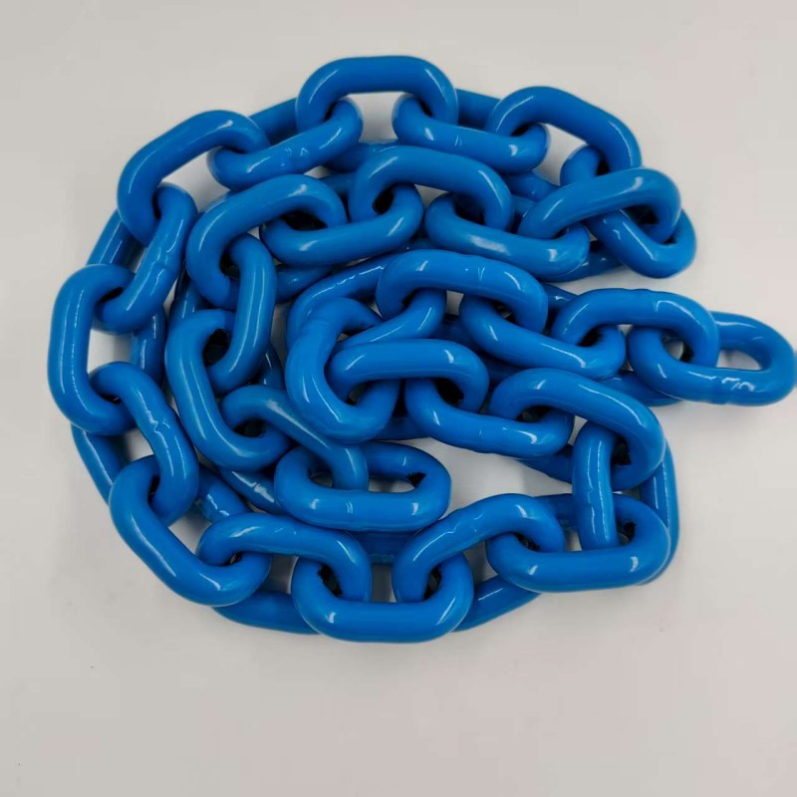
When sourcing Grade 100 lifting chain, most buyers focus on the grade, diameter, and working load limit. But the surface treatment is just as critical — and for G100 chain, the standard finish is not galvanizing or black oxide. It is electrophoretic coating, commonly known as E-coat.
Why Surface Treatment Matters for G100 Chain
G100 chain is the highest-strength welded chain in common industrial use. It is made from premium alloy steel, quenched and tempered to achieve a minimum breaking stress of 1000 N/mm². This extreme strength makes G100 chain the preferred choice for heavy lifting, where every link must perform reliably under high tension.
However, ultra-high-strength steel has a weakness: it is highly sensitive to hydrogen embrittlement. Hydrogen atoms introduced during acid cleaning or electroplating can penetrate the steel and cause sudden, brittle failure under load — often without warning.
This is why ordinary surface treatments are not always suitable for G100 chain. The wrong finish can weaken the chain and create a safety risk that is invisible until it is too late.
The Problem with Traditional Zinc Plating
For lower-grade chains, electro-galvanizing is the most common finish. It provides good corrosion resistance at low cost.
But for G100 chain, standard zinc electroplating carries a significant risk: the acid pickling step before plating can introduce hydrogen into the steel. Unless a subsequent baking process is carefully controlled, the hydrogen remains trapped in the metal structure and weakens the chain.
Hot-dip galvanizing presents a different issue. The molten zinc bath operates at approximately 450°C. For G100 chain, which has already been carefully heat-treated, exposure to this temperature can soften the steel and reduce its carefully engineered mechanical properties.
As a result, many manufacturers avoid conventional zinc coatings for G100 chain altogether.
Why E-Coating Is the Preferred Finish for G100 Chain
Electrophoretic coating avoids the problems of both electroplating and hot-dip galvanizing while providing excellent protection.
How E-Coating Works
E-coating is an electrochemical painting process. The chain is immersed in a water-based paint bath containing charged resin particles. When a direct current is applied, the particles migrate to the chain surface and deposit evenly. The chain is then baked at 160–200°C to cure the coating into a hard, durable film.
This process offers several advantages for G100 chain:
Advantage | Why It Matters for G100 Chain |
|---|---|
No hydrogen embrittlement risk | The process does not rely on aggressive acid pickling, and the baking step further reduces any residual hydrogen risk |
Uniform coverage | The electric field drives coating into every corner of the link, including weld points and contact areas, ensuring complete protection |
Thin, precise film | Typical thickness of 15–35 μm does not change link geometry or interfere with sprocket engagement |
Excellent adhesion | The cured coating bonds tightly to the steel surface and resists peeling |
RoHS / REACH compliant | Water-based E-coat finishes meet European environmental standards |
Professional appearance | Matte black or glossy black finish looks industrial, clean, and premium |
E-Coating vs. Other G100 Chain Finishes
Finish | Corrosion Resistance | Hydrogen Risk | Effect on Dimensions | Appearance | Cost |
|---|---|---|---|---|---|
E-Coat (Black) | Good — 72–200 hrs salt spray | Minimal | Minimal | Matte/gloss black, uniform | Moderate |
Electro-Galvanized | Moderate | Higher if not controlled | Minimal | Bright silver | Low |
Hot-Dip Galvanized | Excellent | Low | Significant — thick coating | Matte grey, rough | High |
Black Oxide | Low | Low | Minimal | Black, easily worn | Lowest |
Dacromet / Zinc Flake | Excellent | Minimal | Very thin | Silver-grey | Highest |
For most G100 chain applications, E-coat delivers the best balance of protection, safety, and dimensional stability.
When Might Other Finishes Be Used?
While E-coat is the default choice for G100 chain, some customers may request alternative finishes for specific applications:
- Galvanized G100 chain — occasionally specified for outdoor or marine use, but must be produced with careful pre-treatment and post-baking to manage hydrogen risk. Many manufacturers refuse to galvanize G100 chain due to strength degradation concerns.
- Black oxide — used for low-cost, indoor applications where corrosion resistance is not a priority.
- Dacromet — specified for very high corrosion resistance without hydrogen risk, but at a premium cost.
If a customer requests galvanized G100 chain, it is worth clarifying the intended application and whether the reduced tensile performance after galvanizing is acceptable.
What to Check When Sourcing G100 Chain
When specifying G100 chain, always confirm the following with your supplier:
- Surface treatment — is it E-coat, black oxide, galvanized, or zinc flake?
- Hydrogen embrittlement control — what process is used to prevent hydrogen damage?
- Coating thickness — will the finish affect sprocket engagement?
- Corrosion resistance — what salt spray rating does the finish provide?
- Certification — is the chain proof load tested and supplied with a mill test certificate?
- Markings — G100 chain should be marked with the grade (100) and manufacturer symbol at regular intervals.
Summary
G100 chain demands a surface treatment that preserves its strength while providing reliable corrosion protection. Traditional zinc coatings introduce risks that many manufacturers are not willing to take on ultra-high-strength steel.
E-coating has become the industry standard because it:
- Eliminates hydrogen embrittlement risk
- Applies evenly across the entire link surface
- Maintains precise link geometry
- Delivers a clean, professional black finish
- Meets European environmental regulations
For buyers, understanding why E-coat is used on G100 chain helps you ask the right questions and choose a supplier who prioritises both performance and safety.
Boyuan Metal supplies G100 lifting chains with electrophoretic black coating as standard, with optional finishes available for special applications. All chains are proof load tested and supplied with full mill test certification. Contact us to discuss your G100 chain requirements or request a quotation.