News & Insights
G50 Stainless or G80 Alloy? Two Different Answers to the Same Question
Both grades are chosen when a job needs more than a commercial chain, but for different reasons. One adds strength to stainless steel; the other is built for rated lifting.
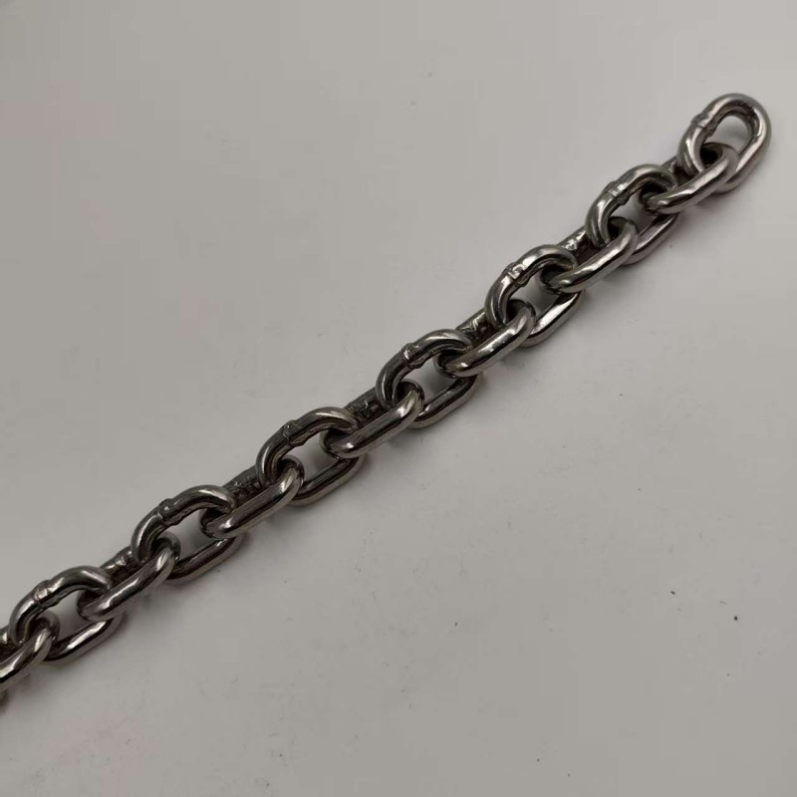
A buyer comparing G50 stainless with G80 alloy is usually asking one question: my commercial chain is not enough, so what do I move up to? These two grades answer different questions. One exists because stainless is normally weak; the other because lifting needs a rated chain. Confusing them is expensive in one direction and unsafe in the other.
What Each Grade Is For
G50 is the higher-strength option within stainless. Ordinary stainless is chosen for corrosion resistance, not strength, and in a food plant, pump station or marine site that can be the limit. G50 keeps the material and raises the grade.
G80 alloy chain is a lifting chain: heat treated alloy steel, grade marked, used with hooks and shackles as a rated assembly within a stated working load limit. Its purpose is not corrosion resistance.
The Corrosion Question Comes First
The order of the decision matters. Ask where the chain lives before asking how strong it needs to be. In a wet, salty, chemical or food-contact environment the material decides: alloy steel corrodes whatever its grade, so a G80 chain in a washdown area is a maintenance problem. Stainless goes there, and if plain stainless is not strong enough, G50 is the step up. In a dry industrial environment corrosion is not the constraint: that is G80 territory.
The Lifting Question Comes Second
This is where the comparison stops being symmetrical. G80 is a grade-marked lifting chain. G50 stainless is a high tensile stainless chain used for pump lifting, submersible equipment and marine and food applications, but that is not the same as a rated lifting assembly. For a load above people, the requirement is a rated chain with matched fittings and a stated working load limit.
A stainless chain can carry a load; what it does not carry is the rating framework overhead lifting requires. On a pump in a sump that is often acceptable, because the area is cleared for maintenance. Above people it is not.
Cost and Weight Move in Different Directions
Alloy steel is the cheaper material: G80 reaches its capacity through heat treatment rather than expensive alloy content, so per unit of strength it is economical. Stainless costs several times more for the same size, and G50 more again than standard stainless.
Where the Two Meet
Installations that want both are usually solved by separating the jobs: a stainless chain takes the permanent, wet, load-bearing run, and the lifting gear is a separate rated assembly brought in for maintenance. Mixing the two is how unrated chain ends up doing lifting work. Our guide to stainless chain for food processing covers the corrosion side in more detail, and G80 or EN 818-2 covers the lifting standards.
Frequently Asked Questions
Is G50 stainless stronger than G80?
They are not measured on the same scale. G50 is a higher tensile grade within stainless steel; G80 is a heat-treated alloy lifting chain with a grade marking and a rated working load limit. Compare them by what the job needs, not by the number alone.
Can I use G50 stainless for lifting?
It will carry a load, but it is not a grade-marked lifting chain with a rated assembly. For overhead lifting above people, use a rated lifting chain with matched fittings and a stated working load limit.
Boyuan Metal supplies G50 high tensile stainless chain in SUS304, AISI316 or AISI316L, bright polished, and G80 alloy lifting chain with matching hooks and shackles. Tell us where the chain will be used and what it will carry, and we will confirm which fits.