Jul 28, 2026Services Overview
How to Choose the Right Lock Chain: Round, D-Type, Square, or Hexagonal?
This guide explains how to evaluate your options and pick the right lock chain for your application.
When selecting a lock chain — for a bicycle, door, gate, or truck wheel — there are far more decisions to make than just the length. Chain shape, material, heat treatment, and surface protection all play critical roles in determining security, weather resistance, and the user's daily experience.
1. Chain Shape: Round, D-Type, Square, or Hexagonal?
The cross-section of a lock chain affects both its physical strength and its resistance to common theft tools.
Shape | Key Characteristics | Best For |
|---|---|---|
Round | Most common. Smooth feel, uniform strength. Easy to coil and store. | General-use locks, lightweight to medium-duty security |
D-Type | Flattened on one side. Sits flush against a surface or lock body. | Integrated lock systems where the chain must align neatly with a housing |
Square | Flat faces. Harder to grip with bolt cutters — the tool tends to slip. | High-security locks, bicycle and motorcycle chains |
Hexagonal | More flat edges than square. Even more difficult for bolt cutters to bite. | Maximum bolt-cutter resistance, premium security |
Practical insight: For customers seeking the best anti-theft performance, square and hexagonal chains are the preferred options. Their flat faces make it nearly impossible for bolt cutters to find a stable cutting angle.
2. Material: Low-Carbon Steel vs. Alloy Steel
The base material determines the chain's core strength, hardness, and workability.
Low-Carbon Steel (Q195)
Q195 is the most widely used material for standard lock chains in the current market. It offers:
- Sufficient strength for everyday use
- Easy forming and welding during production
- Cost-effectiveness for general-quality lock chains
When to use: Everyday padlock chains, indoor or low-risk outdoor applications where cost is a primary concern.
Alloy Steel (20Mn2 and 20CrMnTi)
For high-security applications, alloy steels are the next step up.
- 20Mn2: Offers higher strength and toughness than Q195, with good weldability. Suitable for mid-range to high-end lock chains.
- 20CrMnTi: The best choice for lock chains when cut resistance is the priority. After heat treatment, the chain surface and a certain depth beneath it achieve significantly higher hardness. This is the material of choice for premium anti-theft chains.
When to use: Motorcycle locks, truck wheel locks, door locks in high-risk areas, and any application where bolt-cutter resistance matters.
3. Heat Treatment: For General Use or Cut-Resistant?
Not all lock chains require heat treatment. The decision depends on the security level the end-user expects.
Without Heat Treatment
Chains made from Q195 or 20Mn2 without heat treatment meet the requirements for general-quality locks. They are:
- Cost-effective
- Sufficient for indoor or light outdoor use
- Quick to produce
With Heat Treatment (Mesh Belt Furnace)
For customers requiring high surface hardness and deeper hardenability — that is, cut-resistant chains — we apply heat treatment in a mesh belt furnace.
The process achieves:
- High hardness on the chain surface and at depth
- Resistance to bolt cutters and saws
- Consistent hardness across the full length of the chain
Chains made from 20CrMnTi combined with heat treatment deliver the best anti-cutting performance available on the market.
4. Surface Protection: From Bare Chain to Branded Sleeve
Once the chain is formed and heat-treated (if required), it moves to the finishing stage.
Electro-Galvanizing
The standard finish for lock chains is electro-galvanizing. This provides basic corrosion resistance and a clean, bright appearance. After electro-galvanizing, the chain is ready to use — no further treatment is strictly necessary.
PVC Sleeve
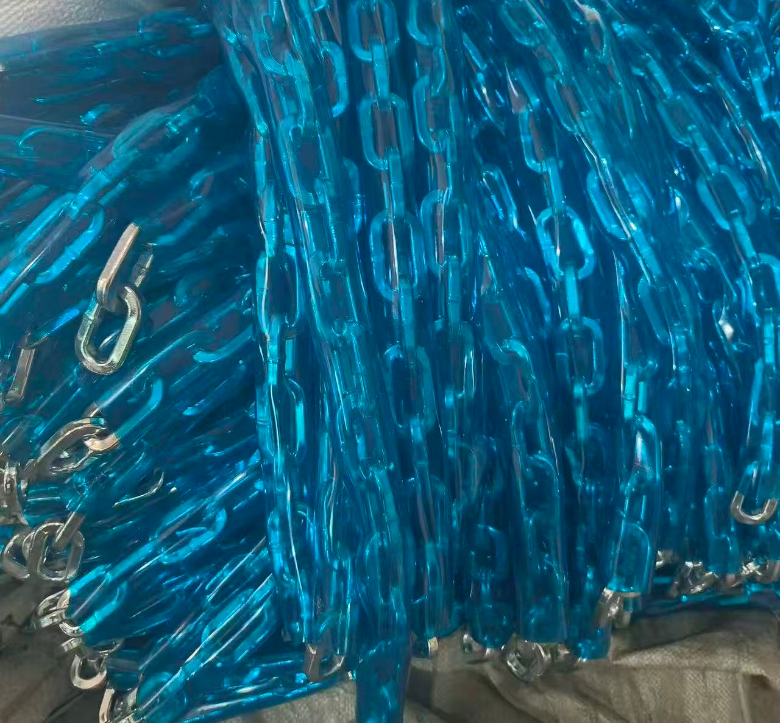
Many customers add a PVC sleeve for extra protection and a better user experience. There are two common types:
- Heat-shrink PVC: The plastic sleeve is heated and shrinks tightly onto the chain. This creates a firm, close fit that stays in place during handling and prevents rattling.
- Inserted PVC tube: The plastic tube is simply inserted around the chain without heat-shrinking. It sits more loosely and is often used where a softer feel or faster production is needed.
Both types protect the chain from moisture, prevent scratches on painted surfaces, and reduce noise. The heat-shrink version is the more professional finish; the loose-fit version is more economical.
Fabric Sleeve with Branding
Some customers request a fabric sleeve instead of PVC. This provides a premium look and feel. The fabric sleeve can be custom-printed with a brand name or logo, turning the chain into a branded product that stands out on the shelf.
5. OEM and ODM: Customize to Your Market
At Boyuan Metal, we support both OEM and ODM production for lock chains:
- OEM: You specify the material, dimensions, shape, finish, and packaging — we manufacture to your exact requirements.
- ODM: We work with you to develop a custom chain design based on your market's needs, from material selection to branded packaging.
Summary: How to Choose
Your Priority | Recommended Specification |
|---|---|
Lowest cost, general use | Round chain, Q195, no heat treatment, electro-galvanized |
Better strength, mid-security | Round or D-type, 20Mn2, optional heat treatment, electro-galvanized + PVC |
High security, cut-resistant | Square or hexagonal, 20CrMnTi, heat-treated, electro-galvanized |
Premium branded product | Square or hexagonal, heat-treated, fabric sleeve with logo |
Contact Boyuan Metal to discuss your lock chain requirements. Whether you need standard specifications or a fully customized product, we'll deliver a solution that fits your market.