Oct 26, 2026News & Insights
How to Read a Chain Test Certificate
A certificate is only useful if it answers the questions a buyer actually has. What a chain test certificate should state, and what to ask for when it does not.
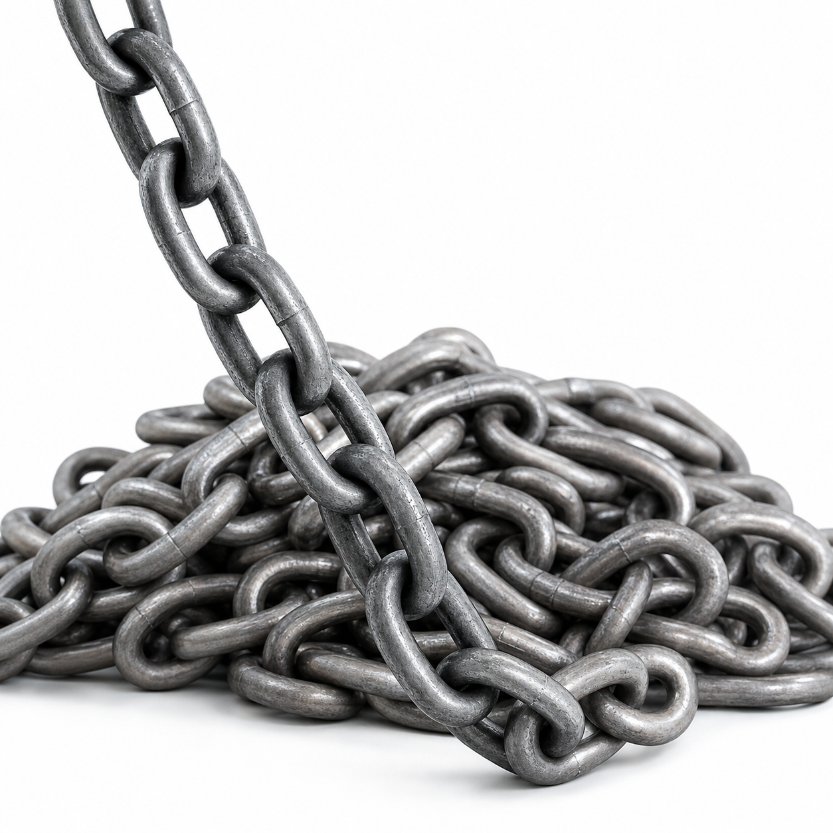
A test certificate is often requested and rarely read. It arrives as a page of references and figures, gets filed, and the buyer is left with the same question: is this the chain I ordered, and has it been tested? Reading it properly comes down to checking a short list of items.
What a Certificate Should Identify
The first job of a certificate is to say what it is about. That means the maker, the product code and description, the nominal dimensions, and the batch or heat number. The batch number is what ties the paper to the chain in the crate - without it, the document could describe anything from that product line. If it does not name the size and batch you ordered, it has confirmed nothing about your order.
What It Should Report
The second job is the test information, and this is the part buyers most often skip. A useful certificate states the standard the chain was made to, the working load and the proof load it was tested against, the test result, the test and issue dates, and the certificate number. It also names two responsibilities: who applied the test, and who signed the certificate. Those items are what convert it from a formality into evidence - the standard fixes the regime, the figures show what the chain actually did, and the signature identifies who stands behind it.
What a Certificate Does Not Tell You
A certificate is a document about a chain, not a guarantee about an assembly. It describes the chain that was tested; it does not cover the hooks, shackles or end fittings added afterwards, nor the way the assembly is used. A lifting assembly is only as good as its weakest part. That is why fittings are specified to match, and why the assembly is inspected as a whole.
What to Ask For
Ask three questions. First ask which standard the chain was made to, so the regime is known. Then ask what working and proof loads are stated and what the test result was, so the figures can be checked against the duty. Finally confirm which certificate travels with this shipment - the one for this batch, not one for a different batch. If any is missing, ask before the chain goes into service.
Frequently Asked Questions
Does a certificate mean the chain is safe to lift with?
No. A certificate is not a guarantee of safety. It shows the chain was made to a stated standard and tested to stated loads. It does not cover the fittings added later or the way the assembly is used, so the assembly still has to be rated and inspected as a whole.
What should a chain test certificate include?
The maker, the product code and description, the nominal dimensions, the batch or heat number, the standard, the working and proof loads, the test result, the test and issue dates, the certificate number, and the two responsibilities - who applied the test and who signed the certificate. Those items let the document be tied to the chain and checked against the duty.
Do general purpose chains come with a certificate?
That depends on the chain and the order. For general purpose chain the useful document is the specification - grade, standard and dimensions - while for lifting chain the test certificate is what to ask for. Tell us the duty and we will confirm what documentation applies.
Boyuan Metal supplies grade 80 lifting chain and grade 100 lifting chain, in grades and standards that can be confirmed against your requirement, and general purpose chain with its grade and standard stated. Tell us the duty and the documentation you need.