Jul 16, 2026News & Insights
Marine Chain: Types, Standards & Selection for Maritime Applications
Marine chain refers to any chain used in a maritime or offshore context
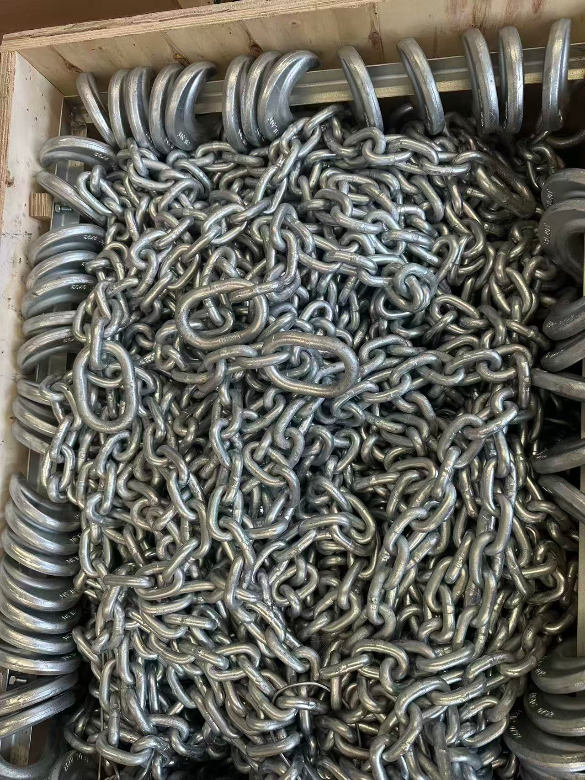
When sourcing chain for marine environments, there is no single "marine chain" — the term covers a broad family of chains, each designed for specific functions aboard vessels, offshore platforms, and coastal installations. Understanding these distinctions is essential for safe, compliant, and cost-effective procurement.
What Is Marine Chain?
Marine chain refers to any chain used in a maritime or offshore context. This includes chains that:
- Hold a vessel in position (anchor chains)
- Secure offshore structures long-term (mooring chains)
- Lift, lash, or secure cargo and equipment onboard (lifting and lashing chains)
Each of these applications imposes different demands on the chain's design, strength, corrosion resistance, and certification requirements.
Type 1: Anchor Chain (Studlink & Studless)
The Gold Standard: Studlink Chain
The most recognisable marine chain is the studlink anchor chain, where a crossbar (stud) is forged into each link. The stud prevents the chain from kinking under load and keeps the links from collapsing when wound onto a windlass.
- Standard: DIN 763 (German standard), IACS W22 (International Association of Classification Societies)
- Grades: U2 (standard strength) and U3 (high strength), with U3 offering approximately 20% higher breaking force than U2
- Diameter range: Typically 12.5mm to 122mm, with larger diameters available for specialised vessels
- Certification: Class society certificates from DNV, ABS, Lloyd's Register, Bureau Veritas, or CCS are normally required. Mill certificates (3.1 or 3.2 per EN 10204) are standard for traceability.
Studlink chain remains the preferred choice for vessels requiring reliable anchor handling, particularly where windlass compatibility and long-term fatigue resistance are critical.
Studless Chain
Smaller vessels may use studless chain (DIN 764) . Without the crossbar, it is lighter and more compact but more prone to tangling under heavy load.
Key Quality Attributes
Industry best practice for marine chain manufacturing emphasises several critical quality attributes:
- Precision link geometry to ensure smooth windlass engagement
- Uniform heat treatment for consistent mechanical properties throughout each link
- Full traceability from raw material to finished chain
- Protective coatings tailored to vessel operating conditions
Type 2: Mooring Chain
Mooring chains permanently anchor floating structures — such as oil and gas platforms, floating wind turbines, and buoy systems — to the seabed.
- Grades: R3, R3S, R4, R5 (increasing in strength and fatigue resistance)
- Diameter range: Typically 76mm to 152mm
- Key requirements: Exceptional fatigue life, high tensile strength, and resistance to hydrogen embrittlement in deep water
Mooring chains are a specialised category and are almost always supplied directly to offshore engineering projects with full class society approval.
Type 3: Marine Lifting & Lashing Chain
Unlike anchor chain, marine lifting and lashing chains are used onboard the vessel for handling cargo, securing equipment, and rigging operations. These chains look more like standard industrial lifting chains — but adapted for the corrosive marine environment.
- Standards: EN 818-2 (Grade 80/G100 lifting chain), DIN 5685
- Finish: Hot-dip galvanized is standard. Stainless steel (AISI 316) is used where maximum corrosion resistance is required
- Fittings: These chains are often part of a complete rigging assembly with G80/G100 shackles, master links, and hooks
Any chain used in marine lifting must meet or exceed the same safety standards as industrial lifting chain — with the added requirement of proven corrosion resistance. Hot-dip galvanized Grade 80 or Grade 100 alloy chain with compatible galvanized fittings is widely recommended for onboard lifting applications.
For small to medium vessel anchoring and mooring, hot-dip galvanized or stainless steel short-link chains provide the necessary combination of strength and saltwater durability.
For mooring and towing applications, chain assemblies should be designed as complete systems — chain, shackles, swivels, and end terminations — with load ratings verified across every component.
Corrosion Protection: The Defining Requirement
The single factor that separates marine chain from industrial chain is corrosion resistance. Saltwater is unforgiving, and inadequate protection leads to rapid deterioration and safety risks.
Finish | Zinc Layer | Typical Application |
|---|---|---|
Electro-Galvanized | 8–12 microns | Light marine use, interior boat fittings |
Hot-Dip Galvanized | 50–80 microns | Shipboard lifting, lashing, general marine hardware |
Thickened Hot-Dip Galvanized | 80+ microns | Long-term outdoor and splash zone exposure |
Stainless Steel (316) | — | Maximum corrosion resistance, premium applications |
Certification: What You Need to Know
For anchor and mooring chains used in classed vessels or offshore installations, third-party certification from a recognised classification society is mandatory. For marine lifting and lashing chains, standard mill test certificates (MTCs) and proof load test certificates are often sufficient — but customers should always verify their specific regulatory requirements before ordering.
How to Select the Right Marine Chain
To specify the correct marine chain, answer these three questions:
- What is the function?
- Holding a vessel in place → Anchor chain (studlink)
- Lifting cargo onboard → Galvanized G80/G100 chain
- Securing equipment on deck → Lashing chain
- What is the operating environment?
- Occasional saltwater exposure → Hot-dip galvanized
- Continuous immersion or splash zone → Thickened galvanized or stainless steel
- What certification is required?
- Classed vessel → DNV, ABS, LR, BV, or CCS certification
- Non-classed vessel or onboard use → MTC and proof load test report
Summary: Marine Chain at a Glance
Type | Standard | Grade | Typical Finish | Certification |
|---|---|---|---|---|
Anchor Chain (Studlink) | DIN 763, IACS W22 | U2, U3 | Hot-dip galvanized or painted | DNV, ABS, LR, BV, CCS |
Mooring Chain | DNV-OS-E302, API 2F | R3, R4, R5 | Hot-dip galvanized | DNV, ABS, etc. |
Marine Lifting Chain | EN 818-2 | G80, G100 | Hot-dip galvanized or 316 SS | MTC, proof load test |
Marine Lashing Chain | DIN 5685 | G80 | Hot-dip galvanized | MTC |
Boyuan Metal supplies hot-dip galvanized and stainless steel chains for marine lifting, lashing, and general onboard applications. For anchor chain and mooring chain enquiries requiring class society certification, we work with approved partner factories to provide compliant solutions.
Contact us to discuss your marine chain requirements — we will help you select the right product for your vessel and operating conditions.