Jul 16, 2026News & Insights
PVC-Coated vs. PE-Coated Wire Rope: Differences, Similarities & Applications
Coating a steel wire rope with plastic is one of the most effective ways to enhance its corrosion resistance, improve handling safety, and extend service life
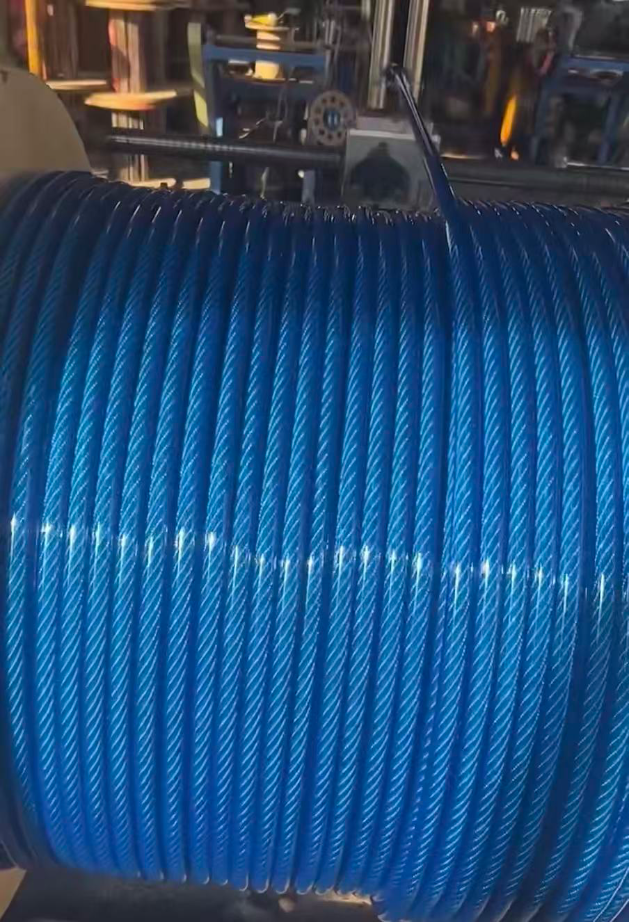
The two most common coating materials are PVC (Polyvinyl Chloride) and PE (Polyethylene) . While they may look similar at first glance, their properties and ideal applications differ significantly.
Common Ground: Why Coat a Wire Rope at All?
Regardless of the material, plastic coating serves the same fundamental purposes:
- Corrosion protection: Seals the steel core from moisture, salt, and chemicals
- Improved safety: Smooth surface eliminates the risk of hand injuries from broken wires
- Noise reduction: Eliminates the metallic clanking sound during handling
- Colour options: Available in various colours for identification, aesthetics, or safety coding
- Surface protection: Prevents the wire rope from scratching or damaging contact surfaces (e.g., painted surfaces, glass, wood)
Both PVC and PE are applied through an extrusion process, where the steel wire rope passes through a die that applies a concentric, uniform layer of molten plastic around the core.
PVC-Coated Wire Rope
Material Properties
PVC is a rigid plastic made flexible through the addition of plasticisers. It has been the dominant coating material for decades due to its low cost and ease of processing.
Property | PVC |
|---|---|
Flexibility | Good — softer and more pliable than PE |
Surface Feel | Smooth, slightly rubbery to the touch |
Abrasion Resistance | Moderate |
UV Resistance | Moderate — can degrade and become brittle after prolonged sun exposure unless UV-stabilised |
Temperature Range | -10°C to +60°C (standard grade) |
Chemical Resistance | Good against acids and alkalis; susceptible to some solvents |
Colour Stability | Moderate — darker colours fade more slowly |
Cost | Lower than PE |
Typical Applications
PVC-coated wire rope is the most common choice for indoor and general-purpose outdoor applications where flexibility and a smooth finish are valued:
- Fitness equipment: Gym cable attachments, weight stacks, resistance systems — PVC's soft feel is preferred for grip
- Retail and display: Hanging displays, shelving, POS systems
- DIY and home use: Clotheslines, pet leads, garden ties, general tie-downs
- Light outdoor use: Temporary fencing, simple barrier systems
- Automotive: Tailgate cables, bonnet release cables, throttle and brake cables (due to flexibility)
PE-Coated Wire Rope
Material Properties
Polyethylene is a simpler, more stable polymer that does not require plasticisers. It is inherently more resistant to environmental factors than PVC.
Property | PE |
|---|---|
Flexibility | Slightly stiffer than PVC, but still flexible |
Surface Feel | Smooth, harder, slightly waxy to the touch |
Abrasion Resistance | Excellent — significantly better than PVC |
UV Resistance | Excellent — naturally resistant to sunlight, does not become brittle |
Temperature Range | -40°C to +80°C (standard grade) |
Chemical Resistance | Excellent — resistant to most chemicals, solvents, and saltwater |
Colour Stability | Good — retains colour well under sunlight |
Cost | Slightly higher than PVC |
Typical Applications
PE-coated wire rope is the preferred choice for demanding outdoor, marine, and industrial environments where durability and weather resistance are critical:
- Marine and coastal: Mooring lines, safety rails, lifelines, fishing gear — PE's saltwater resistance and UV stability are essential
- Playground and outdoor recreation: Swing ropes, climbing structures, zip lines — PE withstands constant sun exposure without degrading
- Construction and industrial: Barrier cables, safety nets, fall protection systems
- Agriculture and horticulture: Greenhouse cables, vineyard trellises, animal enclosures
- Architectural and landscape: Stainless steel wire rope with clear PE coating for balustrades and green walls — PE's transparency and UV stability preserve the aesthetic
PVC vs. PE: Direct Comparison
Dimension | PVC-Coated Wire Rope | PE-Coated Wire Rope |
|---|---|---|
Flexibility & Feel | Softer, more rubbery | Slightly firmer, waxy surface |
Abrasion Resistance | Moderate | Excellent |
UV Resistance | Moderate (requires stabilisers) | Excellent (natural property) |
Low-Temperature Performance | Becomes brittle below -10°C | Remains flexible to -40°C |
High-Temperature Performance | Softens above 60°C | Stable up to 80°C |
Chemical Resistance | Good, but sensitive to some solvents | Excellent, broad chemical tolerance |
Saltwater Resistance | Good | Excellent |
Colour Stability Outdoors | Fades over time | Retains colour well |
Cost | Lower | Slightly higher |
Environmental Profile | Contains chlorine; less eco-friendly in production | Chlorine-free; simpler polymer, cleaner production |
How to Choose: A Practical Guide
Your Application | Recommended Coating |
|---|---|
Indoor gym equipment, retail displays, DIY | PVC — softer feel, lower cost |
Outdoor playground, swing ropes, zip lines | PE — UV resistance prevents embrittlement |
Marine, coastal, fishing | PE — superior saltwater and UV resistance |
Construction, industrial barriers | PE — better abrasion and weather resistance |
Cold climate outdoor use | PE — remains flexible at sub-zero temperatures |
Architectural balustrades, clear coating | PE — better clarity and UV stability |
Budget-sensitive, general-purpose outdoor | PVC (UV-stabilised grade) |
Summary
PVC and PE coatings both protect the steel core and improve handling. The choice comes down to the operating environment:
- Choose PVC when you need a softer feel, indoor or light outdoor use, and a lower price point.
- Choose PE when you need maximum weather resistance, UV stability, and long-term durability outdoors, in marine environments, or in cold climates.
Boyuan Metal supplies wire ropes with both PVC and PE coatings, in a wide range of colours and coating thicknesses. Tell us your application and working environment — we will recommend the right coating for your requirements.