
Oct 26, 2026News & Insights
What Chain Markings Tell You Before You Load It
A grade marking is not decoration. What the stamps on a chain are for, what a lifting chain should carry, and what an unmarked chain is telling you.
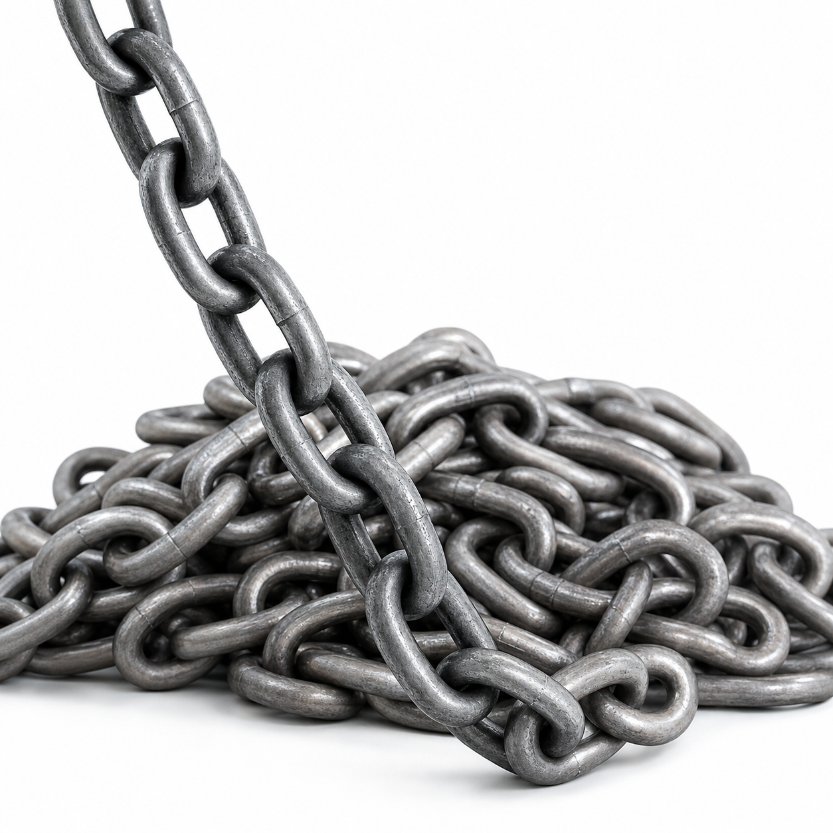
Before a chain takes a load, the markings on it are the first thing to read. They are the maker's statement about what the chain is and what it may be used for, and they matter because a chain that looks identical to another may not be rated the same. Skipping them puts the wrong chain in a lift.
What a Marking Is For
A chain marking is an identification, not decoration. It ties a specific chain to a specific grade, maker and rating. That matters because the same link size can be made in several grades, and the difference is not visible by eye - only by what is marked and documented. The marking lets an inspector confirm they are working with the chain the certificate describes.
What a Lifting Chain Should Carry
Two different places carry the information. The grade and an identifier for the maker or product are stamped on the links, so they travel with the chain. The rating - working load limit, number of legs on a multi-leg sling, nominal chain size and the standard it was made to - belongs on the assembly tag or in the test certificate - it belongs to the assembly, not to the individual link - and the more legs share the load, the more it changes. What is stamped on the links is not the whole document - it is the part that travels with the chain.
Grade Markings on General Purpose Chain
General purpose chain carries its grade too, and the marking matters for a different reason: so nobody mistakes it for a lifting chain. A grade 43 chain is marked grade 43 high test, a general duty and load securement grade. Grade 30 proof coil and grade 70 transport chain carry their own markings for the same reason. Reading the grade tells you which regime it belongs to - and on the general duty grades the answer is: not overhead lifting.
What an Unmarked Chain Is Telling You
An unmarked chain, or one whose marking cannot be read, has a grade that cannot be confirmed. On a lifting assembly that is a stop sign: if you cannot tell the grade, you cannot confirm it is rated for the lift. Take it out rather than assume it matches the chain next to it. In general purpose work it may still serve, but must not be promoted to a duty it was never marked for.
Keeping the Marking Readable
Markings wear off. Abrasion, corrosion and handling take their toll, and a chain whose marking is gone is in the same position as one never marked. That is why chain in demanding service is inspected and the marking checked with the links: if it cannot be read, the chain's identity must be established another way, or it comes out of service.
Frequently Asked Questions
What does a grade marking on a chain mean?
It identifies the strength class the chain was made to. On a lifting chain it is the grade the assembly is rated against; on general purpose chain it tells you the duty grade - and whether it is a lifting chain at all.
Can I use a chain if the marking is worn off?
Not in a lifting assembly. If the grade cannot be confirmed, the chain cannot be confirmed as rated for the lift. In general purpose work it may still serve, but must not be used for a duty it was never marked for.
Does every chain need a marking?
A grade-marked chain does, by definition. A general purpose chain should still carry its grade so it can be identified - an unmarked chain cannot be shown to be anything in particular.
Boyuan Metal supplies grade-marked lifting chain in grades 80 and 100, and general duty chain in the commercial grades. Tell us the duty and we will confirm the grade, size and fittings.