Sep 14, 2026Services Overview
Why Is My Stainless Steel Wire Rope Magnetic?
Magnetism does not mean your wire rope is fake.
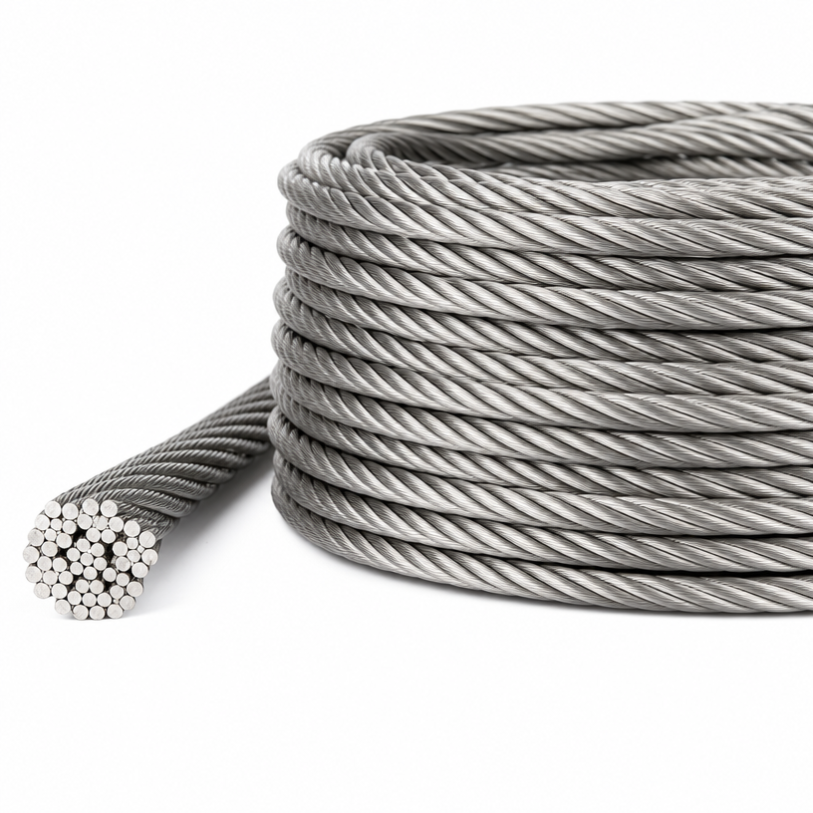
A common question we receive from customers: "I tested my stainless steel wire rope with a magnet — and it sticks. Does this mean it's not real stainless steel?"
The short answer: no, magnetism does not mean your wire rope is fake. Let us explain why.
Why Does Stainless Steel Wire Rope Become Magnetic?
Austenitic stainless steels (such as AISI 304 and 316) are theoretically non-magnetic or only weakly magnetic in their annealed state. However, during the wire rope manufacturing process, the steel undergoes significant cold working — drawing from thick wire rods down to fine wires, plus stranding and closing operations.
This cold working alters the internal microstructure. A portion of the austenite transforms into martensite or ferrite, both of which are magnetic phases. The result: your finished stainless steel wire rope shows some degree of magnetism.
Simple explanation: When you pull a thick stainless steel wire down to a thin diameter, the internal structure changes — and industrial magnetism appears.
Does Magnetism Mean Poor Quality?
No. Magnetism in stainless steel wire rope does not affect:
- Chemical composition
- Physical and mechanical properties
- Corrosion resistance
- Service life
A magnetic stainless steel wire rope performs exactly as its grade specifies. The only reliable methods for verifying stainless steel grade are:
- Spectrometer analysis — the most accurate method
- Chemical testing solutions (such as Moly drop test for 304 vs 316)
A magnet can never tell you whether your wire rope is genuine 304 or 316.
What If the Customer Requires Non-Magnetic Wire Rope?
If your application genuinely requires non-magnetic wire rope, there are two approaches. Both come with trade-offs:
Option 1: High-Manganese Non-Magnetic Steel
Produce the wire rope using specialized high-manganese (high-Mn) non-magnetic steel instead of standard AISI 304 or 316.
Drawbacks:
- Higher raw material cost
- Longer production lead time
Option 2: High-Temperature Annealing (Demagnetization)
Heat-treat the finished wire rope at approximately 700–800°C to reverse the martensite transformation and remove magnetism.
Drawbacks:
- Additional processing cost
- The annealing process reduces the wire rope's breaking strength by approximately 30%
For most industrial lifting and rigging applications, this loss of strength is unacceptable. This is why standard stainless steel wire ropes are supplied in their as-produced, slightly magnetic condition.
304 vs 316 Stainless Steel Wire Rope: Which Should You Choose?
Both grades are austenitic stainless steel and both can become slightly magnetic after cold working. The difference between them matters when corrosion is the deciding factor.
Property | AISI 304 | AISI 316 |
|---|---|---|
Molybdenum content | None | 2-3% |
Chloride / salt resistance | Moderate | High |
Typical environment | Indoor, general outdoor, fresh water | Seawater, coastal, chemical, acidic residues |
Magnetic behaviour | Slightly magnetic after cold working | Slightly magnetic after cold working |
When to choose it | General purpose and cost-sensitive work | Marine, food, chemical and permanent outdoor use |
For permanent salt-water exposure, 316 is the appropriate grade - 304 is not normally recommended for continuous seawater contact. Tell us the environment and we will confirm the grade and construction.
Key Takeaways
Concern | Reality |
|---|---|
"My stainless steel rope is magnetic — is it fake?" | No. Cold working during production creates industrial magnetism. This is normal for 304 and 316 grades. |
"Does magnetism affect quality?" | No. Chemical composition, strength, and corrosion resistance remain unchanged. |
"Can I remove the magnetism?" | Yes, but annealing reduces breaking strength by ~30%. For most lifting applications, this is not recommended. |
"How do I know the real grade?" | Use a spectrometer or chemical test solution — never a magnet. |
"I need truly non-magnetic rope." | This must be specified before production. We can source high-Mn non-magnetic steel, but cost and lead time will increase. |
What Should You Do?
- If your application does not strictly require non-magnetic properties, accept the slight magnetism as a normal characteristic of cold-worked stainless steel wire rope. It does not compromise safety or performance.
- If you absolutely need non-magnetic wire rope, inform us before ordering. We will discuss material options, cost implications, and production timelines with you.
Boyuan Metal supplies stainless steel wire ropes in AISI 304 and 316, with full mill test certificates confirming chemical and mechanical properties. Contact us to discuss your requirements - magnetic or non-magnetic, we'll find the right solution.
Frequently Asked Questions
Does magnetism mean my stainless steel wire rope is fake?
No. Cold working during the wire rope manufacturing process creates industrial magnetism, and this is normal for AISI 304 and 316 grades. It is not a sign of the wrong grade or of inferior quality.
Why does stainless steel wire rope become magnetic?
Austenitic stainless steels such as AISI 304 and 316 are theoretically non-magnetic or only weakly magnetic in their annealed state. During drawing, heavy cold working transforms a portion of the austenite into martensite or ferrite, both of which are magnetic phases.
Does magnetism affect the rope's performance?
No. Magnetism does not affect chemical composition, physical and mechanical properties, corrosion resistance or service life. A magnetic stainless steel wire rope performs exactly as its grade specifies.
How can I verify the stainless steel grade?
Spectrometer analysis is the most accurate method, and chemical testing solutions such as the moly drop test distinguish 304 from 316. A magnet can never tell you whether your wire rope is genuine 304 or 316.
Can I get non-magnetic stainless steel wire rope?
Yes, by two routes: using specialised high-manganese non-magnetic steel, or high-temperature annealing at approximately 700-800 degrees C to reverse the martensite transformation. Both carry trade-offs - each adds cost and extends production time, and the annealing process reduces breaking strength by approximately 30%. For most lifting and rigging applications that strength loss is unacceptable.