Sep 16, 2026News & Insights
Chain and Rigging Hardware for Construction Sites
A construction site needs chain, wire rope and rigging hardware for lifting, securing and restraint. Here is what is normally specified for each job, and what to send for a quotation.
A construction site needs chain, wire rope and rigging hardware for three jobs: lifting, securing and static restraint. The parts can look similar on the same pallet but carry different ratings and different rules, and mixing them is where most site problems start.
Lifting: Graded Chain and Matched Fittings
Use a grade-marked chain and match every fitting to it. Our grade 80 lifting chain is alloy steel such as 20CrNiMo or 20Mn2 to GB/T 20947-2007 and ISO 3077:2001, with a safety factor of 4 times and a manufacturing proof force of 2.5 times the working load limit. Choose grade 100 where a lighter assembly matters, because it carries the same load in a smaller diameter.
Hooks, shackles, eye bolts, eye nuts and connecting links each carry their own grade and working load limit, and the assembly must be matched as a set. DIN 763, DIN 764, DIN 766 and DIN 5685 are general purpose chains, not grade-marked lifting chains, and must not be used for overhead lifting. For a worked example of graded lifting chain, see our black oxide G80 lifting chain.
Securing and Tensioning
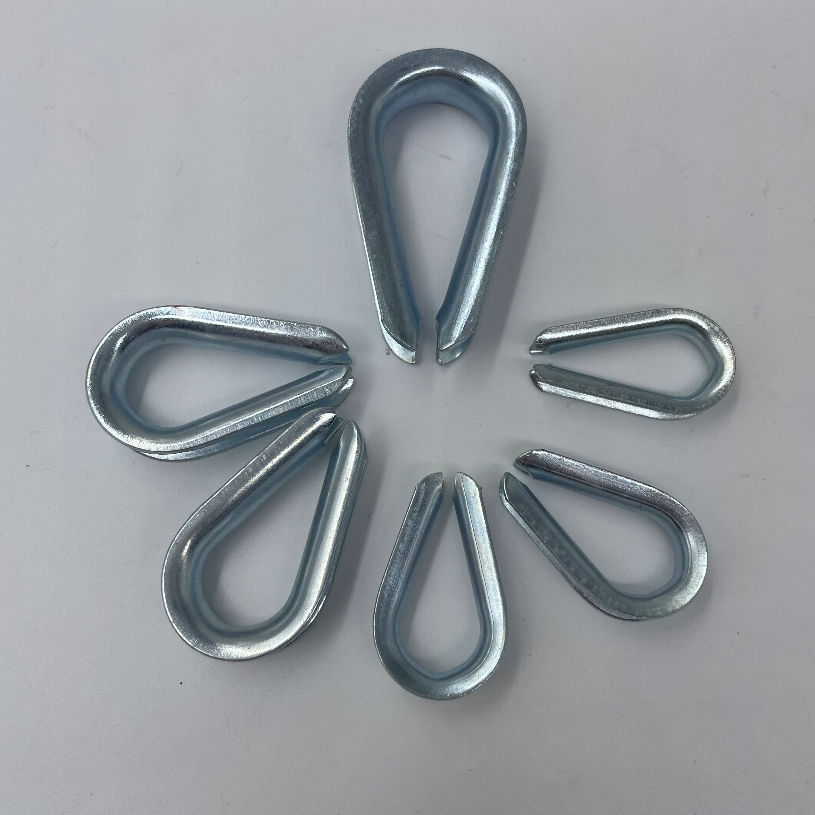
For cargo and plant securing: grade 70 transport chain, turnbuckles, wire rope clips and thimbles. Grade 70 is a heat-treated carbon steel chain for tie-down rather than overhead lifting, identifiable by its golden yellow chromate finish. Turnbuckles to DIN 1480 come with hook-and-eye or hook-and-hook ends; clips are US type drop forged or DIN 741 malleable.
Wire Rope for Long Runs
Wire rope covers guy lines, hoist ropes and static support. The range includes 1x37 and the common six- and eight-strand constructions: 6x7, 6x19, 6x19S, 6x36WS and 6x37 with FC or IWRC core, plus 8x7, 8x19, 8x19S, 8x37 and 8x25Fi, in carbon or stainless steel. A 6x7 rope is stiff and abrasion-resistant, suiting straight pulls; 6x36 and 6x37 bend more easily, suiting sheaves and drums. For the full selection framework, see our how to choose the right steel wire rope.
What to Send for a Quotation
Five inputs settle most enquiries: what the item will do; the working load and safety factor your procedure requires; the environment, which decides material and finish; the length and end terminations; and whether mill test or classification certification is required. For an assembly, list every component so the set can be confirmed at one grade instead of piece by piece.
Frequently Asked Questions
Can I use general purpose chain for lifting on site?
No. DIN 763, DIN 764, DIN 766 and DIN 5685 are general purpose chains and must not be used for overhead lifting. Lifting needs grade 80 or grade 100 alloy chain, matched with fittings of the same grade.
What is grade 70 transport chain for?
Cargo securement and tie-down, not overhead lifting. Grade 70 is a heat-treated carbon steel chain, recognisable by its golden yellow chromate finish.
Which wire rope construction should I choose?
Choose 6x7 where the rope is under straight pull and abrasive conditions, and 6x36 or 6x37 where it bends over sheaves and drums. 1x37 covers static work such as guy lines.
What do you need to quote a complete assembly?
The application, working load and required safety factor, the environment, the length and end terminations, and whether certification is required.
Boyuan Metal manufactures and exports chain, wire rope and rigging hardware, and supplies matched assemblies rather than loose components. Send us the application, the load and the environment, and we will confirm the grade, the diameter and the fittings.