Sep 12, 2026Services Overview
Elevator Compensating Chains: Function, Types & Selection Guide
This guide explains what compensating chains do, how they differ from traction ropes, and what to look for when sourcing them.
In a modern elevator system, the wire ropes that lift the cabin are only part of the equation. As building heights increase, another component becomes essential: the compensating chain.
Compensating chains are also known as compensating ropes or compensation ropes - depending on whether the weight-balancing element is a chain or a rope form. In this guide we cover the chain types used in modern traction elevator systems and how to select between them.
What Is an Elevator Compensating Chain?
A compensating chain hangs beneath the elevator cabin and counterweight, forming a loop at the bottom of the shaft. Its job is simple but critical: balance the weight difference between the cabin side and the counterweight side as the elevator moves.
As an elevator rises, the weight of the hoist ropes shifts from the cabin side to the counterweight side — or vice versa. Without compensation, the drive motor must work against this imbalance, wasting energy and causing uneven wear. The compensating chain offsets this shifting load, keeping the system stable.
Why Not Just Use a Wire Rope?
Traction ropes are designed for tension. A compensating chain, by contrast, hangs freely and must remain flexible, quiet, and dense enough to provide meaningful ballast in a limited space. A steel wire rope, particularly one with a steel core (IWRC), is too stiff and light for this application and would generate unacceptable noise in the shaft.
Want to know more about the hoist ropes themselves? See our elevator steel wire rope 8x19S+IWRC, and for correct fitting, our guide on how to install elevator wire rope covers the process step by step.
Key Performance Requirements
Requirement | Why It Matters |
|---|---|
High linear density (kg/m) | The chain must provide sufficient weight to compensate for the hoist ropes. Every kilogram per meter matters. |
High flexibility | The chain bends repeatedly as the cabin travels. It must withstand millions of flex cycles without fatigue failure. |
Low noise operation | Metallic clanking in an elevator shaft is unacceptable. The chain must run silently. |
Corrosion resistance | Shaft environments can be humid, dusty, or oily. Surface protection must prevent rust over decades of service. |
Abrasion resistance | The outer layer must resist wear from guides and pulleys without cracking or peeling. |
Reliable end connections | The chain attaches to the cabin and counterweight frames. These connections must be secure and fatigue-resistant. |
Two Main Types of Compensating Chains
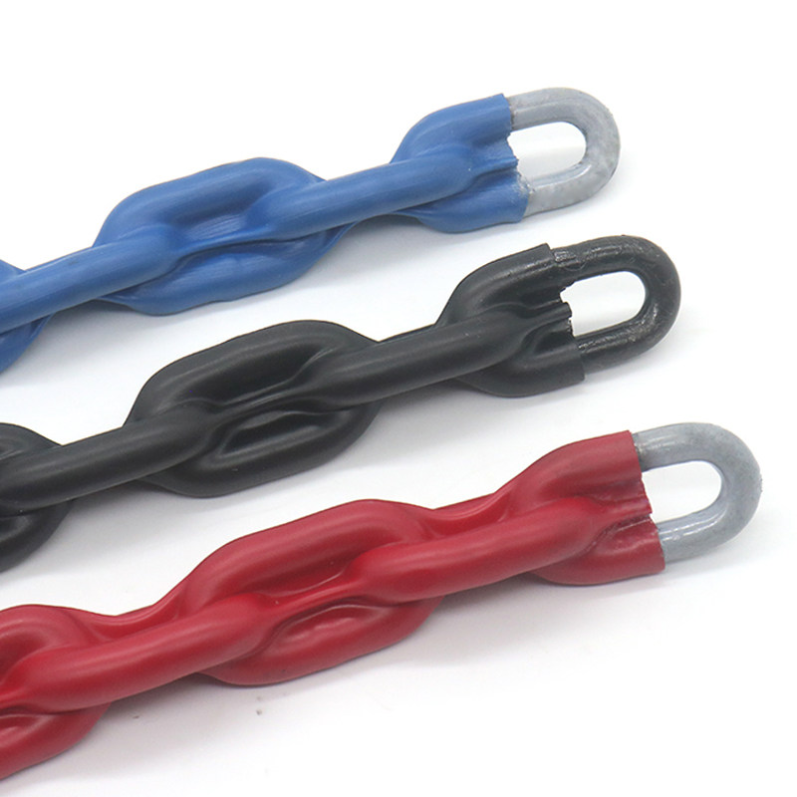
1. Fully Enclosed Plastic-Coated Chain
This is the standard choice for medium to high-speed elevators in commercial and residential buildings.
Construction: A steel link chain is completely encapsulated in a thick, flexible layer of PVC or polyurethane (PU). The plastic coating prevents metal-to-metal contact between links and absorbs vibration.
Advantages:
- Best noise reduction — no metal contact, no clanking
- Smooth exterior protects against corrosion and wear
- Long service life with minimal maintenance
Typical applications: Passenger elevators in offices, hotels, apartments, and any environment where noise is a concern.
2. Rope-Core Chain (Corded Chain)
This is a lower-cost alternative used in slower elevators and simpler installations.
Construction: A fibre rope — natural sisal, nylon, or polypropylene — is threaded through the centre of each chain link. The rope dampens vibration between links without fully enclosing the chain.
Advantages:
- More economical than fully enclosed chain
- Effective noise reduction for low to medium-speed applications
- Simpler production process
Typical applications: Freight elevators, parking garages, and low-speed hydraulic elevators where cost is a primary concern.
Which Type Should You Choose?
Application | Recommended Type |
|---|---|
High-rise, high-speed passenger elevator (>2.5 m/s) | Fully enclosed plastic-coated |
Medium-speed passenger elevator (1.0–2.5 m/s) | Fully enclosed plastic-coated |
Low-speed passenger or freight elevator (<1.0 m/s) | Rope-core or fully enclosed |
Hydraulic elevator | Rope-core |
Budget-sensitive project | Rope-core |
Key Specifications to Confirm
When sourcing compensating chains, the following parameters must be matched to the elevator design:
Parameter | What to Confirm |
|---|---|
Linear weight (kg/m) | The most critical specification. Must match the elevator's compensation calculation. Common values: 1.0–3.5 kg/m. |
Chain link diameter (mm) | The steel wire diameter inside the coating. Determines the chain's tensile strength. |
Overall outer diameter (mm) | The finished chain diameter including coating. Must fit the guide system and pulleys. |
Coating material | PVC or polyurethane. PU offers better abrasion resistance and a wider temperature range. |
Coating thickness | Affects noise reduction, wear life, and outer diameter. |
Length (m) | Custom-cut to the elevator's lifting height plus compensation loop. |
End connections | Shackles, threaded studs, or custom fittings to attach to the cabin and counterweight frames. |
Common Questions
How is compensating chain different from traction wire rope?Traction rope carries the cabin weight under tension. Compensating chain hangs freely and provides weight, not lifting force. The two serve opposite functions in the same system.
How long does a compensating chain last?With proper specification and installation, a fully enclosed chain can last 10–15 years or longer. The plastic coating should remain intact without cracking or exposing the steel core.
What causes compensating chain noise?Noise usually comes from metal links striking each other or the shaft wall. Fully enclosed chains eliminate this entirely. Rope-core chains reduce it significantly compared to bare chain.
Can I use a standard PVC-coated chain?No. Elevator compensating chains use a specialised thick, flexible, and often fire-retardant coating designed for continuous bending and long-term dynamic use. Standard PVC coating for security chains or general hardware is not suitable.
Summary
A compensating chain is a deceptively simple component that plays a vital role in elevator performance. The right chain, correctly specified, runs silently and reliably for years. The wrong choice leads to noise complaints, premature wear, and costly replacements.
Key takeaways for buyers:
- Confirm the exact linear weight (kg/m) required
- Choose fully enclosed chain for passenger elevators, rope-core for freight or budget projects
- Verify coating material, thickness, and fire-retardant properties
- Specify end connections clearly
- Provide the elevator's lifting height and speed to your supplier
Boyuan Metal supplies elevator compensating chains in both fully enclosed and rope-core constructions, with custom lengths, linear weights, and end connections to match your elevator specifications. Contact us to discuss your requirements or request a quotation.
Frequently Asked Questions
What is the difference between a compensating chain and a compensating rope?
A compensating chain uses steel links - fully plastic-coated or rope-core - while a compensating rope is the rope form of the same weight-balancing component. Both hang in a loop between the car and the counterweight and do the same job: balancing the weight of the hoist ropes over the travel of the elevator. Which form suits the installation depends on the elevator speed and noise requirements.
What is compensating rope used for?
It balances the weight of the hoist ropes in a traction elevator system. As the car rises, the weight on the counterweight side grows; the compensating element offsets this so the machine sees a stable load. It is used in mid- and high-rise installations where rope weight would otherwise unbalance the system.
How is the weight of a compensating chain chosen?
The linear weight must be matched to the elevator's design so the balance stays correct over the full travel. Confirm the required weight per metre with the elevator manufacturer or the machine specification, and we will supply the chain to match.