Sep 16, 2026News & Insights
Hot Dip Galvanized Chain: Process and Uses
How hot dip galvanizing protects chain: the 440-465C zinc bath, 50-80 micron coating, ISO 1461, and where it outperforms electro galvanized in outdoor use.
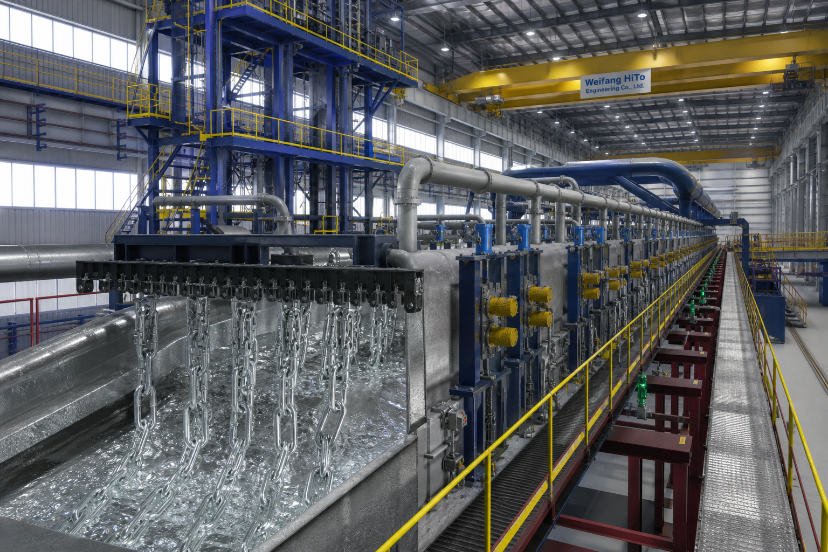
When a chain needs to withstand years of outdoor exposure, saltwater, chemicals, or heavy industrial use, hot dip galvanizing is the most reliable corrosion protection available. Unlike electro galvanizing, which applies a thin zinc layer at room temperature, hot dip galvanizing immerses the steel chain in molten zinc at approximately 450°C, forming a metallurgically bonded, multi-layer coating that can last for decades.
The process is often written both ways - "hot dip galvanizing" for the treatment and "hot dipped galvanized chain" for the finished product. Both refer to the same zinc coating described in this guide.
What Is Hot Dip Galvanizing?
Hot dip galvanizing is a process in which steel is immersed in a bath of molten zinc at 440–465°C. The zinc reacts with the steel to form a series of zinc-iron alloy layers, topped with an outer layer of pure zinc. The result is a coating that is:
- Thick — typically 50–80 microns, compared to 8–25 microns for electro galvanized
- Metallurgically bonded — the zinc and steel interlock at the atomic level, so the coating does not peel or flake
- Sacrificial — if the coating is scratched, the surrounding zinc corrodes first, protecting the exposed steel
The Hot Dip Galvanizing Process
Step 1: Surface Preparation
Before galvanizing, the chain surface must be completely free of oil, rust, and mill scale. Any contamination will prevent the zinc from bonding.
Stage | What Happens |
|---|---|
Degreasing | Alkaline solution removes oils and lubricants |
Rinsing | Water removes residual chemicals |
Pickling | Acid bath removes rust and mill scale |
Rinsing | Water removes acid residue |
Fluxing | Zinc ammonium chloride solution prevents re-oxidation and helps the zinc wet the steel surface |
Drying | Chain is preheated to approximately 100°C before entering the zinc bath |
The flux step is especially important for chains. The interlocking links make it difficult to keep contact points clean, and the flux coating protects those areas during the transfer to the zinc bath.
Step 2: Immersion in Molten Zinc
The prepared chain is immersed in molten zinc at ~450°C. A metallurgical reaction takes place, forming multiple zinc-iron alloy layers:
Layer | Composition | Characteristics |
|---|---|---|
Gamma (innermost) | High iron content | Hard, thin, closest to the steel |
Delta | Zinc-iron alloy | Dense and well-bonded |
Zeta | Zinc-iron alloy | Columnar crystal structure |
Eta (outermost) | Pure zinc | Soft, provides sacrificial protection |
Special considerations for chains:
- Chains are moved or vibrated during immersion to ensure zinc reaches the contact points between links
- After withdrawal, centrifugal spinning removes excess zinc and prevents links from sticking together
- Smaller diameter chains (under 6mm) require shorter immersion times to avoid excessive alloy growth, which can make the chain brittle
Step 3: Cooling and Post-Treatment
After galvanizing, the chain is cooled — either in air or by water quenching. A passivation treatment may be applied to prevent early white rust formation during storage and transport.
White rust is a powdery white deposit that forms when fresh zinc reacts with moisture. It is not structurally damaging, but it affects appearance. Passivation creates a thin barrier that delays white rust, keeping the chain looking clean during transit and storage.
Electro Galvanized vs. Hot Dip Galvanized
Property | Electro Galvanized | Hot Dip Galvanized |
|---|---|---|
Process temperature | Room temperature | ~450°C |
Bonding | Physical deposition | Metallurgical (Zn-Fe alloy layers) |
Coating thickness | 8–25 microns | 50–80+ microns |
Corrosion resistance | Moderate — indoor and light outdoor use | Excellent — marine, industrial, heavy outdoor |
Appearance | Bright, smooth, silver-white | Matte grey, slightly textured |
Abrasion resistance | Moderate | High — alloy layers are hard (up to 250 HV) |
Service life outdoors | 2–8 years | 15–50 years |
Cost | Lower | Higher (2–4×) |
When to choose electro galvanized: Your chain needs a clean, attractive look at a competitive price, and will be used indoors or in moderate outdoor conditions.
When to choose hot dip galvanized: Your chain will face harsh outdoor exposure, saltwater, chemicals, or heavy wear — and long-term durability matters more than the initial cost.
Common Applications
Sector | Typical Uses | Why Hot Dip Galvanized |
|---|---|---|
Marine & offshore | Anchor chains, mooring lines, winch chains, pump lifting chains | Saltwater corrosion resistance; sacrificial protection if scratched |
Agriculture | Manure scraper chains, fertilizer spreader chains, barn systems | Resists moisture, ammonia, and chemical corrosion |
Outdoor conveying | Sand, gravel, waste, and recycling conveyors | Weather-resistant; hard surface resists abrasive wear |
Urban infrastructure | Barrier chains, bike rack chains, playground equipment | Long outdoor life with zero maintenance |
Industrial | Chemical plant conveyors, water treatment pump chains | Resists corrosive gases and liquids |
Playgrounds | Swing chains, climbing equipment chains | Smooth, safe surface; weather-resistant; compliant with EN 1176 |
Quality Standards
Hot dip galvanized chains are manufactured to ISO 1461, which specifies minimum coating thickness:
Steel Thickness | Minimum Coating Thickness |
|---|---|
≥ 6mm | 70–85 microns |
3mm to < 6mm | 55–70 microns |
1.5mm to < 3mm | 45–55 microns |
For most industrial chains, the 70–85 micron range applies. Marine applications often call for the thicker end of this range, or even 80+ microns for extended service life.
Selecting the Right Hot Dip Galvanized Chain
Factor | What to Consider |
|---|---|
Chain type | Calibrated (DIN 766) for sprockets; long-link (DIN 763) for barriers; stud-link for marine anchoring |
Diameter | Selected based on required working load |
Chain grade | G30, G43, G50, G70 — higher grade offers more strength for the same diameter |
Coating thickness | Standard: 50–80 microns; Marine/extended life: 80+ microns |
Certification | Marine classification (DNV, ABS, LR, RINA) available upon request |
Packaging | Bundles, drums, reels, or boxes depending on quantity and sales channel |
Maintenance and Service Life
Hot dip galvanized chains require minimal maintenance. A few simple practices extend service life further:
- Rinse with fresh water after marine or outdoor exposure
- Inspect periodically for red rust, elongation, or damaged links
- Replace when elongation exceeds 3–5% or diameter reduces by more than 10%
Expected service life:
- Inland/urban: 20–50 years
- Industrial: 15–25 years
- Marine/coastal: 8–15 years
Frequently Asked Questions
How long does hot dip galvanized chain last outdoors?Typically 15–50 years, depending on environment. Marine exposure reduces this to 8–15 years.
Can hot dip galvanized chain be used for lifting?Only if manufactured to Grade 80 or Grade 100 with appropriate certification. Standard galvanized commercial chain is not rated for lifting.
Does hot dip galvanizing change the chain dimensions?Yes — the coating adds approximately 50–80 microns per surface, slightly increasing diameter and pitch. This should be accounted for in tight-tolerance applications.
What is white rust and how do I prevent it?White rust is a harmless but unsightly zinc corrosion product that forms in humid conditions. Passivation treatment and dry storage prevent it.
Can hot dip galvanized chains be welded?Welding burns off the zinc coating and produces hazardous fumes. If welding is necessary, reapply zinc-rich paint to the weld area.
Is it 'hot dip galvanized' or 'hot dipped galvanized'?Both are correct and describe the same coating. Industry writes "hot dip galvanizing" for the process and "hot dipped galvanized chain" for the finished product. The treatment is identical: steel immersed in molten zinc to form a bonded zinc-iron alloy layer.
What does 'chains for galvanising' mean?It refers to chain supplied for, or already through, the galvanising process. Almost any carbon or alloy steel chain can be hot dip galvanized, but a chain intended for lifting must be manufactured to Grade 80 or Grade 100 and certified before coating, because the coating is not a substitute for the correct grade.
Is it 'galvanising' or 'galvanizing'?The same word. Galvanising is UK and Australian spelling, galvanizing is US spelling. Both refer to the zinc coating process described on this page.
How thick is the zinc coating on a hot dipped galvanized chain?Typically 50–80 microns, compared with 8–25 microns for electro galvanized. Coating thickness is specified by ISO 1461, which sets minimum thickness according to steel thickness.
Boyuan Metal supplies hot dip galvanized chains in carbon steel and alloy steel, covering multiple grades (G30–G80) and standards (DIN 766, DIN 763, DIN 5685, ISO 4565). Our standard hot dip galvanized coating reaches 50–80 microns, with thickened coatings of 80+ microns available for marine applications.
Contact us to discuss your requirements or request a quotation.
The following hot dip galvanized chain for your reference: