
Oct 7, 2026News & Insights
Wire Rope for Balustrades and Cable Railings
Architectural cable is wire rope you can see, and it does a fall-protection job. How it is chosen, tensioned and fitted - and why it is safety-critical work.
A balustrade or cable railing is wire rope you can see, doing a job you cannot ignore. It fills the gap in a stair, balcony or landing guard, and it is a load-bearing, safety-critical part of the building, not a decoration. That is architectural wire rope, chosen and fitted very differently from rope used to lift a load.
What Architectural Cable Is
Architectural cable is wire rope used as the visible infill, and in some designs the structural cable, of a balustrade, railing, stair or balcony guard. People lean on it and it forms part of a fall-protection barrier, so it is load-bearing and safety-critical: it must be engineered and installed to code by a competent installer, not fitted by guesswork. The stainless steel wire rope is the usual product, in 1x7, 7x7 or 1x19.
Why Stainless Steel
Two reasons decide it. Outdoors, and near the sea, the cable has to resist weather and salt, so stainless is chosen for corrosion resistance in marine and outdoor environments. And because the cable is on show, its bright finish is why stainless is picked where the cable will be seen. The rope comes in SUS304, AISI316 or AISI316L.
Construction: Stiff or Flexible
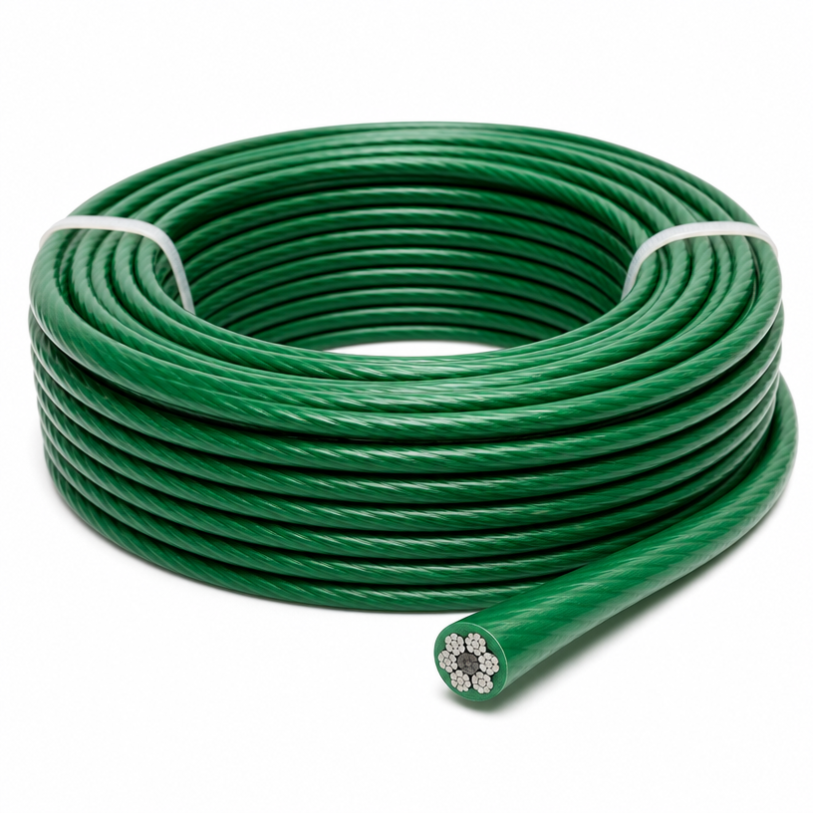
Construction follows the design. A straight, taut run of deck or balustrade cable is often 1x19, a stiffer rope that stays clean and straight over a long span. Where the cable bends round a corner or follows a curve, a flexible construction such as 7x7 suits better. The full picture is in our guide to wire rope constructions. Where colour or extra protection is wanted, a PVC coated wire rope is used for railings and guard lines, the jacket keeping moisture off the rope and protecting people from the wire.
Fittings and Tensioning
Architectural cable needs fittings that tension it and hold its ends. A turnbuckle pulls the cable taut and adjusts it, and a wire rope thimble lines each eye so it keeps its shape on a pin or anchor. Cable is tensioned firmly but not over-stressed, and the anchor at each end must be as sound as the cable itself.
Safety: Load-Bearing and to Code
One point sits above all the others. Balustrade and architectural cable work is load-bearing and safety-critical, and must be engineered and installed to code by a competent installer. It is a fall-protection barrier, not a lifting sling, and not a do-it-yourself item: the design, anchors and tensioning all have to be right together.
Frequently Asked Questions
What wire rope is used for balustrades?
Stainless steel wire rope, usually in 1x7, 7x7 or 1x19, available in SUS304, AISI316 or AISI316L. Stainless is chosen for corrosion resistance outdoors and for the bright finish a visible cable needs.
Can balustrade cable be used as a lifting sling?
No. Architectural cable is a fall-protection and railing component, not a lifting sling. Lifting uses rope and fittings rated and assembled for the job, and the two must not be mixed.
How is architectural cable tensioned?
With a turnbuckle in the run, which pulls the cable taut and lets it be adjusted later. The eye ends are lined with a thimble, and the anchors are set so the whole assembly holds as designed.
Boyuan Metal supplies stainless steel wire rope in 1x7, 7x7 and 1x19, PVC coated wire rope, and the turnbuckles, thimbles and clips for an architectural cable assembly. Tell us the rope, the span and the fittings, and we will confirm the parts.